
Hickory Public Records Coverage
North Carolina law starts with broad access, yet each record set has its own keeper and limits. Hickory has no citywide records database. Deeds follow the parcel county, court files follow the proper Clerk of Superior Court, and vital certificates follow the event county or state office. An index may identify a filing without displaying its image.
| Hickory record | Official keeper | Web route | Access path |
|---|---|---|---|
| Deeds, liens, plats | Parcel county Register of Deeds | County-linked vendor index | Index, counter, mail, certified copy |
| Civil, criminal, estates | County Clerk of Superior Court | eCourts Portal and Court Dates | Portal, public terminal, clerk copy |
| Property and tax | County Tax/GIS office | Parcel and tax-bill searches | Free current roll; office archives vary |
| Birth, death, marriage | Register of Deeds and NC Vital Records | Order portal, not a free name index | Inspection and copy rules vary |
| Police incident facts | Hickory Police Records Division | Forms page and request form | Download, fax, mail, or counter |
| Jail and corrections | Sheriff or NC Adult Correction | County jail and state offender tools | Current public fields; scope differs |
Chapter 132 covers records made or received in public business across many forms. It does not open sealed cases, juvenile and adoption files, protected addresses, individual ballots, or confidential identifiers. A portal can also satisfy access when a record can be viewed and saved there. When no portal result appears, the counter, written request, local library, or State Archives may still be the proper next channel.
Hickory's Three-County Records Map
A Hickory postal address does not settle jurisdiction. Most of the city lies in Catawba County. Western portions extend into Burke County, and small northern portions can involve Caldwell County. Land filings, parcel cards, marriage licenses, court venue, and voter registration follow the county tied to the parcel, event, case, or residence. Newton is Catawba's county seat, Morganton is Burke's, and Lenoir is Caldwell's.
Begin with Catawba for most Hickory matters. If a western parcel or event is missing, check Burke. Add Caldwell when the address or official map points north. A mailing city can say Hickory while the land lies outside Catawba. Court venue also depends on the event, parties, property, and procedural rules.
Note: County boundaries control the custodian, so a clean no-result in Catawba may call for Burke or Caldwell rather than a broader name search.
Hickory Deed Records Access
The Register of Deeds records deeds, deeds of trust, liens, plats, assumed names, and marriage licenses. Search the county where the land lies. The linked index may support party, grantor, grantee, instrument, or book-and-page routes, but the exact online start year was not verified. Older books, index gaps, plats, and certified copies belong at the register's counter or written-request channel. The State Archives County Records Guide identifies surviving historical series.
The official Catawba County Register of Deeds service page gathers recorded-document and vital-service routes for most Hickory filings.
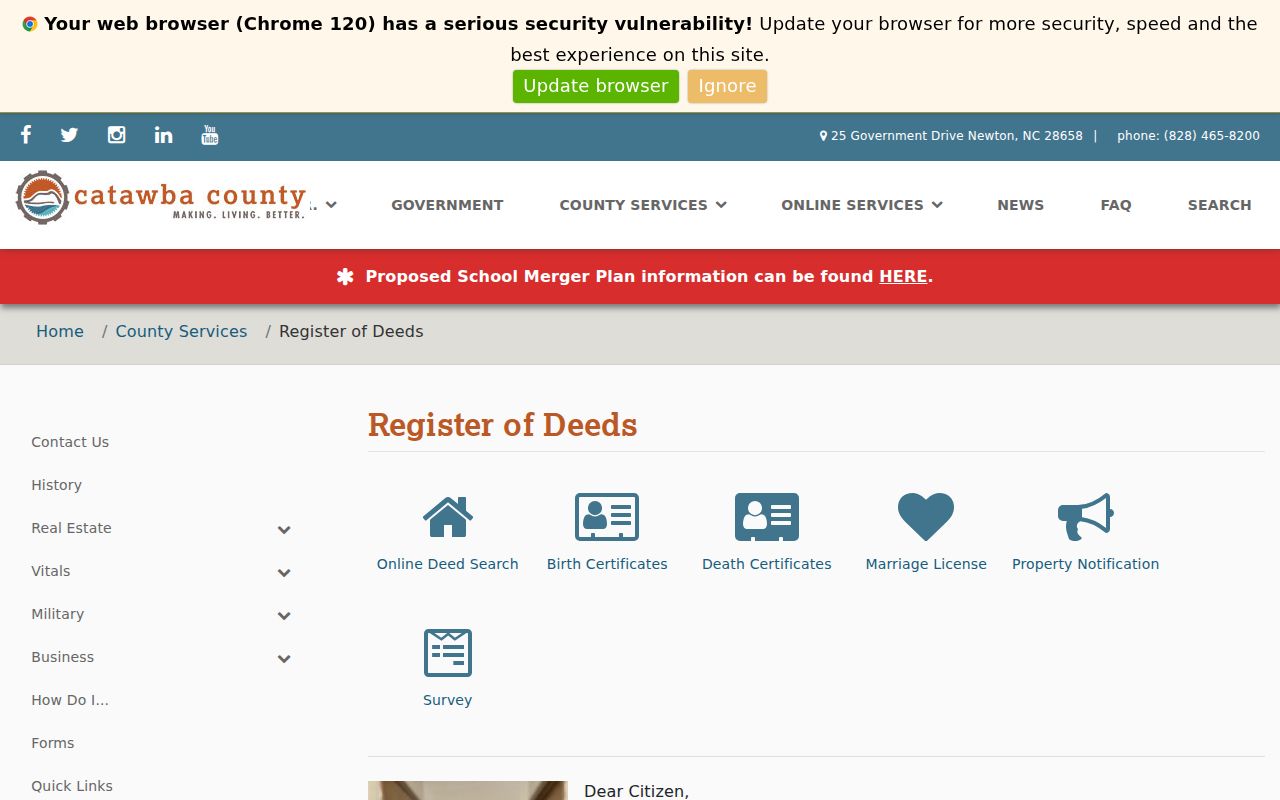
The captured page is a service hub, not proof of the vendor index's oldest searchable year. Record the book, page, or instrument number, then ask for an authoritative or certified copy when needed. Catawba deed records date to the county's creation in 1842. Earlier land research follows Lincoln County or another predecessor series.
Hickory Property Records Reality
The Catawba Real Estate Search ties an owner to a parcel, mailing address, situs address, parcel number, values, and a deed reference when those fields are present. Situs means the physical location of the land. Mailing address means the place where the tax office contacts the owner. Neither field proves who currently lives at the property.
| Search control | Input | Required | Best use |
|---|---|---|---|
| Owner Name | Text | No | Current titled owner or entity |
| Street Number | Number/text | No | Pair with a street name |
| Street Name | Text | No | Try without the suffix if unsure |
| Parcel ID / PIN | Text | No | Exact parcel route |
| Map / GIS | Map action | No | Open land details by location |
| Search / Clear | Buttons | Not applicable | Run or reset the query |
Insider tip: an owner mailing address can be a strong official contact lead for land held by someone who lives elsewhere. GIS data may trail a new deed by three or four weeks. Use the deed office when a recent transfer matters. A tax record proves titled ownership, not who now lives there.
Hickory Court Records Routes
The statewide eCourts Portal searches public case records by record number, person-name parts, business name, and advanced filters. A result may show the case number, court, case type, filing date, parties and roles, events, hearings, and status. Documents vary. Sealed, expunged, juvenile, adoption, and other confidential matters do not appear.
Use NC Court Dates for a defendant name or citation number, then select Catawba, Burke, or Caldwell as needed. A calendar is not a full docket. Save the exact case number and ask the proper Clerk of Superior Court for the public file or certified copy. Public terminals can expose material that is not remotely available, while older matters may require paper or microfilm retrieval.
Estates and special proceedings also sit with the clerk. Public files may include wills, inventories, accountings, and heir notices. Divorce decrees come from the clerk, while NC Vital Records supplies a different certificate.
Note: Common names can collide in a portal, so confirm county, role, dates, and case number before treating a result as the right person.
Hickory Vital Records Channels
Birth, death, and marriage records begin with the Register of Deeds for the event county. The clerk holds the divorce decree and litigation file. NC Vital Records is the statewide route for registered events, but its service portal is an order and case-management system rather than a free public name index. Certified copies require the relationship, identity, and eligibility rules that apply to the product.
The NC Vital Records service portal starts requests by event type, subject name, event date and place, requester details, relationship, identification, quantity, delivery, and payment.
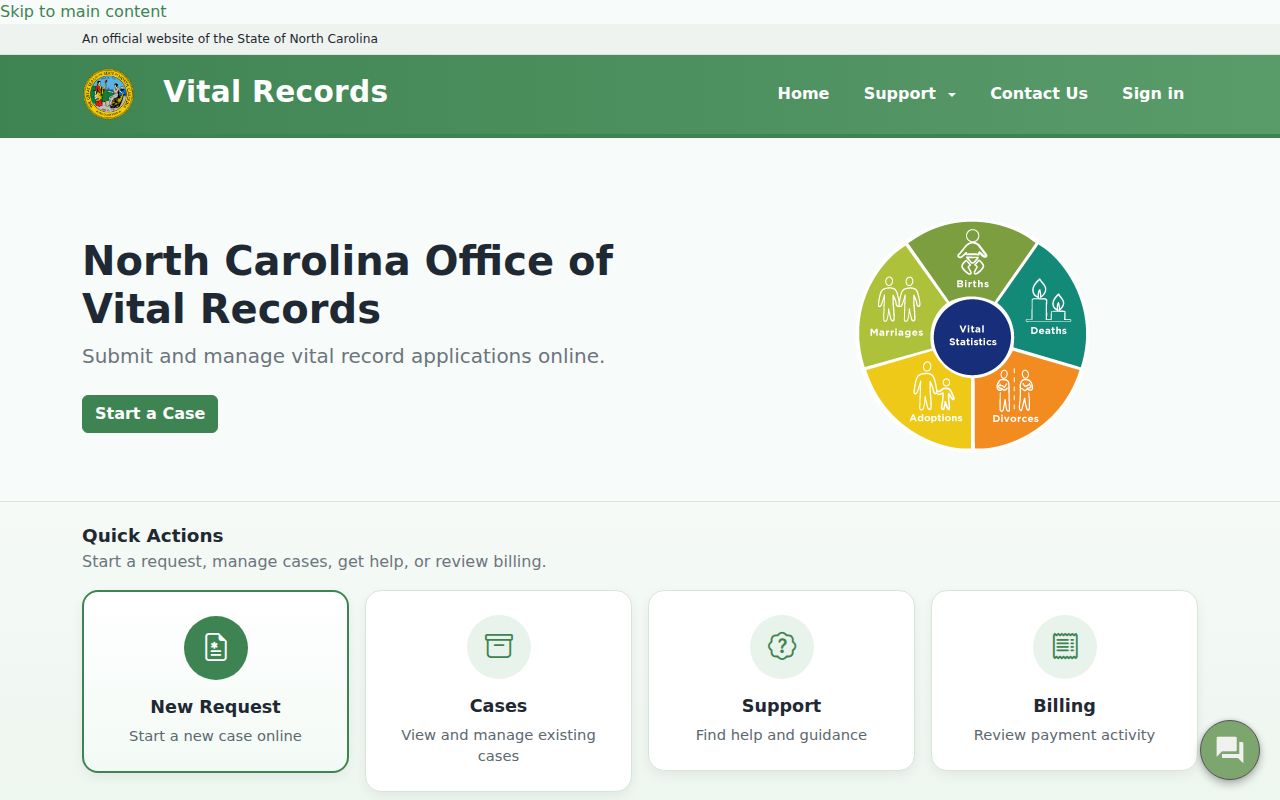
The captured screen shows request actions, not a searchable certificate list. A county office handles local copies, the state offers statewide service, the clerk supplies divorce decrees, and archives or Hickory Public Library can help with older indexes. Library holdings include a 1915 through 1989 obituary index and Shuford Funeral Home records from 1908 through 1957.
North Carolina does not use a simple rule that all births close for one set period and all deaths for another. G.S. 130A-99 permits inspection and uncertified copies or abstracts of county-filed birth and death certificates, while G.S. 130A-93 limits certified copies and protects specified birth fields. In 2026, Catawba expanded local access to most adoptive birth certificates for people born in the county, subject to enhanced restrictions.
Hickory Public Safety Records
The Hickory Police forms hub links a public-information request form for report details, addresses, and date ranges. It may be faxed, mailed, or hand delivered; writing is an aid, not a legal requirement. The Records Division is at 347 Second Avenue SW. Reports are available Monday through Friday, 8 a.m. to 5 p.m. Pickup costs $3, while download is free. Location checks require five working days.
Ask for the specific public incident or collision information. G.S. 132-1.4 opens enumerated incident facts, not the whole criminal investigation or intelligence file. Protected caller, victim, witness, and security details may be withheld. For custody, the county jail route covers county detention, while the NC Adult Correction search covers state corrections. The statewide offender registry has its own statutory scope. A jail entry is not a full court file, and a state corrections result is not a list of every arrest.
Note: Ask for the named public incident fields rather than assuming the complete police investigation is open.
Hickory Public Records Offices
North Carolina divides records work among distinct custodians. A Register of Deeds is not the court clerk, and the city clerk does not control county parcel or court files. Use the office that created or controls the record. The local contacts below cover the most common Catawba and city routes, with Burke or Caldwell equivalents needed when the event, land, or case falls there.
Catawba Clerk of Superior Court
Catawba County Justice Center, Newton
828-695-6100
City departments keep their own files. The Hickory contact directory identifies Legal as a request channel, while Police has a separate form. A focused request belongs with the office that controls the record.
Hickory Records Terms Defined
Official systems use a few terms that change what a search result means. Knowing the difference prevents a portal hit from being mistaken for a complete or authenticated file.
- Custodian
- The agency or official that controls the record and responds to an access request.
- Index
- A searchable list of filings and key facts. It may not include the document image.
- Certified copy
- A copy authenticated by the issuing office for uses that require official proof.
- Exemption
- A law that keeps a record or particular field from public access.
- Grantor and grantee
- The party transferring an interest in land and the party receiving it.
- Redaction
- The removal or masking of protected details while the public portion remains available.
A docket is the court's event and filing record, not always every pleading. A parcel or PIN identifies land in tax and GIS systems. These distinctions guide copy and redaction requests.
Limits on Hickory Public Records
Myth: calling a file a public record does not mean every field is open or that the file must be online. Juvenile and adoption records, sealed or expunged cases, individual ballots, confidential voter identifiers, Social Security numbers, protected financial and government identifiers, alarm-registration data, and Address Confidentiality Program locations remain closed or limited. DMV personal data also follows federal privacy law.
G.S. 132-11 contains a general 100-year sunset for some state-law confidentiality limits, but important exceptions remain. It does not promise that every old vital certificate or sealed court file becomes downloadable. Public incident facts do not open a whole police investigation, and an eCourts omission does not prove no case ever existed. Ask which exemption applies and whether a redacted public portion can be released.
Redact Hickory Record Identifiers
G.S. 132-1.10 lets a person ask a register or clerk to remove specified identifiers from an image displayed to the public. Covered details include Social Security and taxpayer numbers, driver or state identification numbers, passport numbers, account or card numbers, and PINs or passwords. The signed request must identify the recorded document, the protected information, and its exact location on the image.
No fee is charged for a valid redaction request. This process removes the listed identifier from the public display; it is not a general deletion right for the full record. North Carolina also has no verified California-style universal data-broker deletion law. Address Confidentiality Program protection works through a substitute address and special handling, but it cannot erase land already deeded in a participant's name.
Note: A precise book, page, instrument number, and image location gives the register or clerk the detail needed to act on a redaction request.
Request Hickory Public Records
North Carolina Public Records Law gives any person inspection rights at reasonable times and under reasonable supervision. G.S. 132-6 requires copies as promptly as possible after lawful fees. There is no fixed number of business days. Under G.S. 132-6.2, an ordinary copy charge may not exceed actual cost, though extensive technology, clerical, or supervisory work can support a special service charge. Ask for an estimate before authorizing broad work.
- Identify the agency that created or controls the record. Resolve the county before asking for deeds, court files, or event records.
- Describe the type, date range, names, address, and known case, parcel, book, page, or instrument number. Request an existing electronic format when useful.
- Ask to inspect first or receive a saved copy. A written request helps define scope, but special legal wording is usually not required.
- Request the ordinary copy cost and any special service estimate. Narrow the date range or fields if the proposed work is extensive.
- For mixed files, ask for the segregable, redacted public portion. If denied, request the exact statutory exemption and decision in writing.
- Chapter 132 permits civil enforcement. Preserve the request, response, fee estimate, and stated basis for denial if further review is needed.
Lawful use. Use Hickory public records for lawful personal research, civic review, genealogy, estate work, or fraud prevention. Never use a record to stalk, threaten, harass, or target a person, and do not try to defeat a protected-address program.
A response may be a portal link, clarification request, estimate, redacted release, or the records. Custodians provide existing files, not new analysis. If the web index fails, use the counter, mail, archive, or library channel for the missing format or date range.